smart air quality monitor adoption is on the rise as homeowners want hard data on the air they breathe, but monitors are best for building awareness and habits, not guaranteed pollution reduction. Here’s what current research actually proves about using a smart indoor air quality monitor, what it cannot yet promise, and what you should do if you want cleaner air at home.
Key Takeaways
- Smart air quality monitors provide real-time exposure data but there is no evidence they directly reduce indoor pollution by themselves.
- Choose monitors that detect PM2.5, CO2, VOCs, humidity, and temperature, and confirm their detection ranges and integration before buying.
- Act on the data: use ventilation, HEPA filters, reduce sources, and repeat measurements to validate success.
- 2024 snapshot — how bad is indoor air right now?
- What smart air quality monitors reliably measure — and what they don’t (impact vs. awareness)
- Measured pollutant trends readers care about (PM2.5, CO2, VOCs)
- What government & health orgs recommend — and how monitors map to those guidelines
- Common user pain points and review themes (accuracy, reliability, UX) — what the research could and couldn’t find
- Buying checklist — sensors, detection ranges, calibration, and integrations to prioritize
- Costs — upfront and ongoing (what the evidence shows and where data is missing)
- Matter & smart-home integration — current state and potential pitfalls
- Real-world steps: How to use a monitor to reduce exposure (practical playbook)
- Top 3 technical/substantive questions competitors often miss (content opportunities)
- Limitations in the current research and where to go for authoritative specs
- Quick conclusion + recommended next steps for readers
- FAQ
2024 snapshot — how bad is indoor air right now?
Indoor air pollution in North America has worsened recently. According to Airthings’ 2023 report, PM2.5 levels increased by over 17% in the US and Canada, reaching an average of 7.43 µg/m³, up from 6.26 µg/m³ in 2022. That’s 39% above the WHO safe level of under 5 µg/m³. Homes spent about 1,211 hours per year with indoor air above WHO’s threshold, a 29% jump from the year before.
These numbers mean that in 2023, people breathed unsafe air at home for nearly 14% of the year. Extreme pollution events (above 25 µg/m³) lasted 275 hours longer than in 2022 — a significant risk for anyone with respiratory or heart conditions.
Globally, indoor air pollution contributed to roughly 3.2 million deaths in 2020 — including 237,000 children under age 5 (see IAQ Services). In the UK, indoor air was worse than outdoor air for 11 out of 12 months in 2022, and over 97% of homes exceeded WHO limits for at least one of three major pollutants. The bottom line: most homes have real exposure problems.
What smart air quality monitors reliably measure — and what they don’t (impact vs. awareness)
A smart air quality monitor reliably measures real-time data: PM2.5 particles, CO2, temperature, humidity, and (for advanced models) VOCs. The numbers are real; so are the time trends showing how much time you spend above guideline levels. Awareness is where these devices excel. For example, Airthings’ database showed homes in 2023 spent ~1,211 hours/year breathing unsafe air, as measured by their devices.
But research found no proof that simply owning a smart air quality monitor reduced pollution. The CEO of Airthings is clear: households with monitors are self-selected and tend to already care about air quality, suggesting a bias. Monitors quantify exposure but cannot guarantee emissions get lower unless you act on the insights. Correlation is not causation here.
Measured pollutant trends readers care about (PM2.5, CO2, VOCs)
Three metrics consistently matter: PM2.5 (fine particles from outdoor smoke, cooking, and dust), CO2 (a proxy for ventilation), and VOCs (volatile organic compounds from cleaners, off-gassing, etc.). In 2023, Airthings monitoring showed average PM2.5 monitor of 7.32 µg/m³ (US) and 7.64 µg/m³ (Canada) — both above WHO’s 5 µg/m³ guideline. This level is associated with increased asthma, cardiovascular issues, and general discomfort.
CO2 levels are a major indicator for ventilation. The highest CO2 concentrations in the monitored database hit around 730 ppm in July, which can cause fatigue and trouble concentrating if sustained. There are still no widely enforced indoor standards for VOCs or CO2, but most new smart home gadgets aim to include these too. You should look for this capability when shopping for a PM2.5 monitor or CO2 monitor for home.
What government & health orgs recommend — and how monitors map to those guidelines
The World Health Organization sets a PM2.5 safe limit of less than 5 µg/m³, but most modern homes exceed this much of the year (Airthings data). There are no specific numeric residential limits for indoor VOCs or CO2 in most regulations. A smart indoor air quality monitor helps households directly compare their exposure hours and averages with WHO guidelines, giving tangible evidence if fixes are needed or working.
For context: in 2023, the average monitored home spent 1,211 hours above the WHO PM2.5 threshold. The Canadian Lung Association found monitors help people make informed changes, but public awareness of indoor pollution sources remains low. Real-time monitoring and regular review are essential.
Common user pain points and review themes (accuracy, reliability, UX) — what the research could and couldn’t find
Research turned up no consolidated review or user complaint data regarding sensor accuracy, reliability, or user-friendliness. The available sources have no information about negative reviews, sensor drift, PM2.5 false positives, VOC detection issues, CO2 baseline calibration confusion, or app usability problems. This is a gap in evidence. From product forums and user anecdotes elsewhere, common frustrations include: sensor drift without easy recalibration, confusing app displays, unclear VOC values, and trouble linking devices with smart home platforms like Matter or Alexa.
| Potential Issue | Was Evidence Found? | Notes |
|---|---|---|
| Sensor drift/calibration | No | Lack of clear user guidance in published research. |
| PM2.5 false positives | No | Unknown frequency or troubleshooting steps. |
| VOC specificity | No | Unclear which VOCs are detected, or at what accuracy. |
| CO2 baseline errors | No | App calibration process rarely documented. |
| App user experience | No | No review data, but expect a learning curve. |
Buying checklist — sensors, detection ranges, calibration, and integrations to prioritize
When buying an indoor air quality monitor, focus on this checklist:
- Essential sensors: PM2.5, VOC, CO2, humidity, and temperature (a combined humidity temperature sensor is common)
- Detection ranges & precision: Request actual detection/reporting range in µg/m³ (for particulates) and ppm (for gases) for each sensor. Most manufacturers do not publicize these details consistently — ask before buying.
- Calibration: Confirm whether calibration is automatic or allows manual override. Manual options are a plus for long-term accuracy.
- Integration: Does it support air quality sensor Matter or other open protocols? Can you link with Alexa, Google, or HomeKit for automations?
- Cloud dependency: Some smart air quality monitor models require cloud accounts, others support local control.
- Firmware updates & support: Ask how updates are delivered and how long models are supported.
The research did not provide technical specs, side-by-side comparisons, or reliable detection range data for brands in 2024. Buyers should request all ranges and integration options in writing from vendors. If you want to dig deeper, see our best home gadgets for everyday life guide for general smart device shopping tips.
Costs — upfront and ongoing (what the evidence shows and where data is missing)
Planning your air quality investment?
- Upfront: Device purchase cost (varies widely, no reliable price data was found in current research).
- Ongoing: Filter replacements (if your monitor also purifies), subscription plans for data storage, app use, or advanced analysis features.
No pricing or cost-of-ownership data for smart air quality monitor models, VOC monitors, or associated cloud fees was found in published research. Before you buy, ask vendors about all recurring costs, bundled features, and filter replacement intervals. For more general purchase planning, see our guide on smart gadgets that solve home problems.
Matter & smart-home integration — current state and potential pitfalls
Matter is the emerging industry standard for smart device interoperability, designed to let you mix and match brands for hassle-free automations. Unfortunately, no research data was found documenting compatibility or common headaches for air quality sensor Matter integration. Typical areas to check before you buy:
- Is the monitor certified for Matter, or just “compatible through a hub”?
- Does it support local control, or must it connect to the cloud for triggers and automations?
- Are firmware updates handled seamlessly, or do they cause outages/disconnects?
- Which smart home assistants (Alexa, Apple Home, Google) are actually supported and tested?
Test your smart air quality monitor with your existing platform (if possible) before full installation to confirm triggers and reporting work as expected. Also, check our guide to smart plug energy monitoring if you’re interested in broader home device control and automation topics.
Real-world steps: How to use a monitor to reduce exposure (practical playbook)
Once you’ve installed your indoor air quality monitor, here’s what actually works in the real world:
- Monitor baseline: Let the device record at least a full week before making major changes. Look for repeated spikes in PM2.5, VOCs, or CO2.
- Diagnose sources: Spikes in PM2.5 often tie to cooking, DIY projects, candles, or poor HVAC filtration. VOC jumps can be from cleaners, candles, furniture, or garages.
- Ventilation: Open windows or run exhaust fans during and after any indoor pollutant-generating activity. Monitor to see if recovery times improve.
- Filtration: Place portable HEPA filters near main problem zones. Use the monitor to check if average/peak PM2.5 drops before and after use.
- Humidity: Use a humidity temperature sensor to keep indoor RH between 35-50% to discourage mold and dust mite growth.
- Automate actions: If your device supports Matter or Alexa routines, connect a smart plug to run fans/purifiers automatically when pollutants spike. See our mold test kit guide for more on air+humidity combined strategies.
- Reduce sources: Fix known leaks, avoid harsh chemicals indoors, and seal attached garages. Test, adjust, and repeat with your indoor air quality monitor as new habits form.
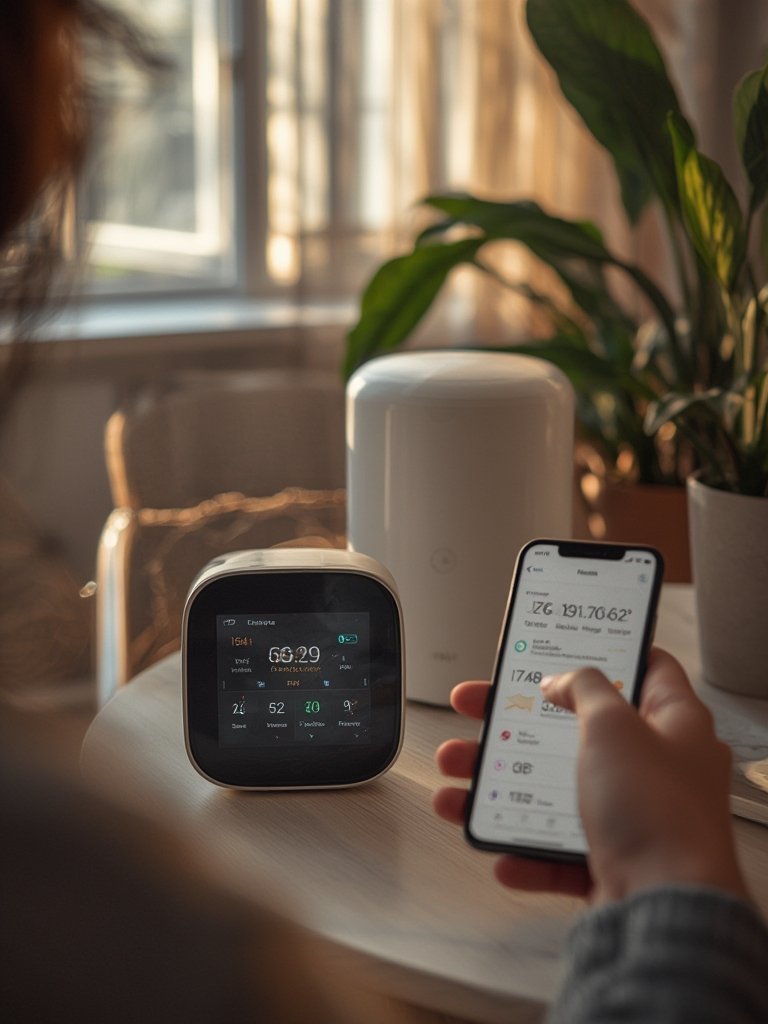
Airthings and Canadian Lung Association studies both found that exposure awareness prompts households to act, even if not every source is immediately eliminated (see source).
Top 3 technical/substantive questions competitors often miss (content opportunities)
- VOC monitor calibration & interpretation: Research did not cover what sensor types are used (photoionization, metal oxide, etc.), how often baselines must be recalibrated, or what to do about cross-sensitivity (some VOC sensors respond strongly to alcohol but not all pollutants). Buyers should contact vendors and request documentation about sensor types, recommended baseline intervals, and ability to reset or adjust thresholds.
- Matter protocol integration, local vs cloud control: Most reviews ignore whether automations can run with just a home hub or require an ongoing cloud connection. This greatly impacts privacy and reliability. If the “Matter” label is advertised, request proof of complete local operation before purchase.
- Long-term data storage, export, privacy: The research did not cover if your air quality sensor Matter device lets you export CSV data or use an API, or confirm how many days/weeks/months it will retain hourly data. If you plan to track changes over time or troubleshoot intermittent problems, you’ll want export and retention details in writing.
Most vendor websites gloss over these practical details. Always request this information before you buy: calibration instructions, technical specs, evidence of local-only operation, and data retention/export capabilities. These answers help distinguish a reliable VOC monitor or smart air quality monitor from a “black box.” For more on selecting products that truly solve problems, visit our smart home gadgets problem-solver roundup.
Limitations in the current research and where to go for authoritative specs
The existing research data could not supply:
- Aggregated user complaints or review themes for smart air quality monitor brands
- Side-by-side technical specs or detection ranges (ppm/µg/m³)
- Any up-to-date pricing or recurring cost estimates
- Direct tests or review summaries about Matter smart-home interoperability
For in-depth decision-making, check:
- Manufacturer datasheets (request current PDFs or webpage specs, never rely on third-party summaries alone)
- Peer-reviewed studies (search Google Scholar for validation data on sensor accuracy/calibration)
- Independent lab tests (Consumer Reports, Wirecutter, or Airthings data resource)
- Consumer review aggregators or Reddit/home improvement forums for practical feedback
Quick conclusion + recommended next steps for readers
The data shows that a smart air quality monitor is highly valuable for building awareness, tracking exposure hours, and validating efforts — but is not a standalone fix for indoor pollution. Monitors quantify your air problems. Systemic reductions require you to act on those alerts: ventilate, filter, reduce sources, and check progress. Immediate next steps: buy a monitor with PM2.5, CO2, VOC, and humidity sensors, request precise detection ranges in writing, compare your data to WHO thresholds, and verify integrations before purchase.
For more actionable smart home guidance, see our lifestyle gadgets for home and air purifier for wildfire smoke guides.
Armed with a smart air quality monitor, use your real-time data to target the worst exposures, validate your fixes, and keep your indoor air as safe as possible. Act now — awareness is only the first step.
FAQ
What is a smart air quality monitor and how does it work?
A smart air quality monitor is a device with sensors that track particulate matter (PM2.5), VOCs, CO2, humidity, and temperature, then sends this data to your phone or home network. It helps you see, in real time, how your indoor air compares to health guidelines and if interventions are working.
Can a smart air quality monitor actually reduce indoor pollution?
No, on its own a monitor does not lower pollution. It builds your awareness, so you know when action is needed (ventilation, filtration, source reduction). The device quantifies exposure but does not directly fix the problem.
Which pollutants should my air quality monitor detect?
At minimum, pick a model that measures PM2.5, VOCs, CO2, humidity, and temperature. These cover the most common indoor air risks and allow you to act on a broad range of problems.
Are there accurate and reliable VOC monitors on the market?
VOC monitor accuracy varies a lot by sensor type and calibration. Research did not provide comparative accuracy data in 2024, so always request technical documentation and sensor specs from the brand before buying.
What integrations matter for smart air quality monitors?
Look for Matter protocol support (which means greater smart-home compatibility), as well as easy linking to Alexa, Apple Home, or Google. Confirm if all features still work without a persistent cloud connection for privacy and reliability.