Matter smart lighting is quickly becoming the default conversation for tech-forward homeowners looking for reliable, futureproof, and cross-platform smart lighting—yet adoption risks, hidden costs, and real-world tradeoffs are still less clear than the advertising suggests.
Key Takeaways
- Matter-certified smart bulbs are now approaching mainstream prices (USD 12 avg) and unlock Apple, Google, Alexa, and SmartThings compatibility, but fewer than 30 percent of smart lighting products are Matter-ready as of mid-2025.
- Choosing between smart switches and smart bulbs depends on your budget, wiring, and whether you want per-fixture or per-room automation. Switches require electricians but reduce device count.
- Matter over Thread offers self-healing mesh reliability and standardized setup. However, buyers should watch for incomplete device ecosystems, supply chain volatility, and the need for consistent firmware support.
- Quick market snapshot — Why Matter matters right now
- Top buyer question: Matter smart bulbs vs smart switches — Which to pick?
- Real-world costs & ongoing expenses (bulbs, hubs/border routers, installation, maintenance)
- Connectivity & technical comparison — Matter over Thread vs Zigbee, Z-Wave, Wi-Fi
- Response time, latency, and energy use — What to expect
- Availability & performance: dimmable bulbs and smart LED strips with Matter
- Common user pain points and real negative review themes (setup, compatibility, reliability)
- Smart lighting scenes & UX — Matter’s cross-ecosystem advantages and limits
- Troubleshooting & advanced setup (deep practical fixes)
- Security, privacy, and vendor lock-in
- Futureproofing & ROI
- Practical buying & installation checklist
- Short FAQs buyers search for
- Recommended next steps & product shortlist methodology
Quick market snapshot — Why Matter matters right now
Matter smart bulbs is not just a spec sheet trend. In 2024, the global smart lighting market size ranged from USD 15.7 to 27.52 billion, with projections as high as 165.89 billion by 2034, growing at almost 20 percent CAGR. Less than 30 percent of all smart lighting products had Matter certification in mid-2025, but adoption is accelerating due to demand for devices that just work across Apple, Google, Alexa, and SmartThings. That said, most buyers will still face a fragmented retail shelf and inconsistent firmware. Price trends are positive: average Matter-certified smart bulb prices dropped 22 percent in a single year to a USD 12 average, making cross-platform smart bulbs finally an option for mainstream retrofits. However, full Matter-certified coverage across all lighting categories is still a few years out, so planning for partial compatibility is unavoidable.
Top buyer question: Matter smart bulbs vs smart switches — Which to pick?
Buyers typically face two core approaches to Matter smart lighting: do you swap out every bulb, or retrofit your smart switches and keep using regular bulbs? Here’s how the tradeoffs break down.
- Smart bulbs: Simple install per fixture. No rewiring, fits most table/floor lamps. You get granular per-lamp control and features (color, scheduling, scenes). Major downside is device sprawl and the risk of someone turning off the wall switch, breaking power to your bulbs.
- Smart switches: One per circuit controls many fixtures. Best for rooms with ceiling lights, multi-fixture zones, and homes with existing wiring. Usually requires an electrician for safe, code-compliant wiring. Sometimes limits advanced color or dimming unless combined with compatible bulbs.
In 2025, Matter-certified smart bulbs average around USD 12, so a five-room home with 15 bulbs totals USD 180 before tax. Smart switches typically cost USD 30-60 each, but installation by an electrician can push the all-in cost to USD 100-200 per switch. Legacy hubs (needed for Zigbee/Z-Wave) cost USD 200-500 per building, but Matter can use existing Wi-Fi or Thread border routers (more on this in the next section).
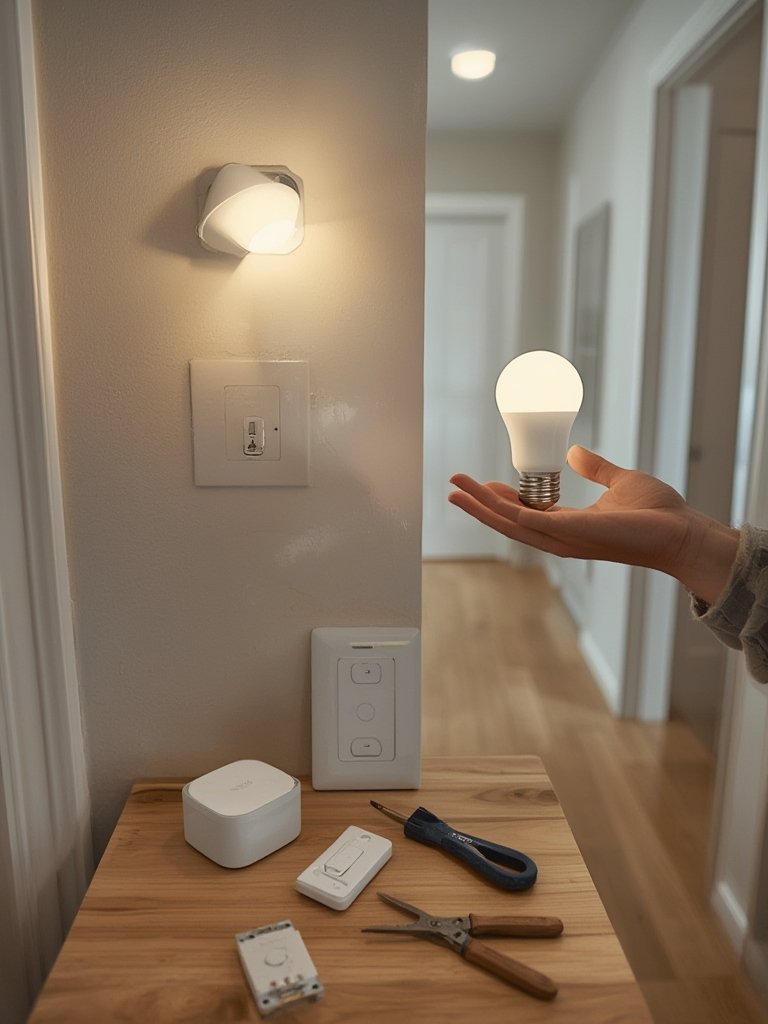
When should you favor switches instead of bulbs? Hallways, kitchens, external lighting, and any zone with multiple fixtures tied to one hardwired switch are best candidates. Bulbs shine where you can’t or don’t want to touch the mains wiring—think table lamps, bedside lights, or for offices with mismatched fixtures.
Real-world costs & ongoing expenses (bulbs, hubs/border routers, installation, maintenance)
Let’s break down what you’ll spend over the first year and ongoing. This is where the sticker price of hardware is only part of the story.
| Expense Category | Matter Smart Bulbs | Matter-Compatible Smart Switches |
|---|---|---|
| Hardware Cost (per device) | ~USD 12 (2025 avg) | USD 30-60 |
| Installation | DIY screw-in | Most require electrician (USD 60-150 per switch install) |
| Extra Hardware | No extra hub for Matter (uses Wi-Fi or Thread border router) | Some products need neutral wire (older homes may not have) |
| Ongoing Maintenance | Occasional firmware/app updates | Rare (unless firmware update) |
| Typical Energy Savings* | 23%+ (automation, dimming, occupancy sensors) | Similar, but limited if using old bulbs |
*Helvar study; results vary by automation use
If you have Zigbee or Z-Wave devices, plan for extra USD 200-500 for gateways, plus the complexity of managing mixed platforms. If you’re aiming for the cleanest plug-and-play experience, use Thread or Wi-Fi-based Matter devices; most modern router brands (Google Nest, Eero, Thread border router) already double as Thread border routers.
Connectivity & technical comparison — Matter over Thread vs Zigbee, Z-Wave, Wi-Fi
Wading into protocol talk is unavoidable for reliability. Matter over Thread brings proven advantages: it is a low-power mesh that self-heals, supports up to 250 nodes (and theoretically thousands in commercial installs), and uses a single commissioning code for seamless onboarding. This eliminates many of the fragmentation woes found pre-Matter, like unstable Zigbee routes or Wi-Fi bulbs that drop off your network whenever there’s interference. Wired PoE or Ethernet options still held around 65 percent of market share in 2024 for absolute reliability—especially in commercial properties. In homes, wireless is the sweet spot for flexibility, but note that Wi-Fi-only bulbs can hammer your router if you have dozens of devices. Thread helps distribute the load and improves local communication.
Thread’s biggest pitch is that it requires no manual route setup. If a device fails, the mesh finds a new path automatically. Commissioning is done with a single QR code that works across Apple, Google, or Amazon platforms, reducing setup friction versus old ecosystems where each device might need its own separate app or hub.
Response time, latency, and energy use — What to expect
Most users perceive Matter over Thread bulbs as “instant” for routine toggles, dimming, and scenes, because commands are issued locally over your home network, not the cloud. By comparison, older Wi-Fi or cloud-only bulbs often lag or fail when the internet is unstable. As of now, there are no published, standardized latency tests for Matter vs. competing protocols, but industry reviews and user feedback suggest Thread-based Matter bulbs are much more consistent and rarely fail to respond.
Energy use is another draw, with LED smart bulbs and optimized automation (occupancy sensors, daylight harvesting) delivering documented savings in the real world. Installations using AI or advanced scheduling—like Helvar’s commercial spaces—report as much as 23 percent lower energy usage. Rates will vary at home but using dimmable bulbs, motion-activated scenes, or time-of-day control can materially cut bills, especially compared to “always-on” legacy fixtures.
For more ways to monitor and reduce your energy bill, see our home energy monitor guide.
Availability & performance: dimmable bulbs and smart LED strips with Matter
Currently, only a subset of dimmable smart bulbs and LED strips carry Matter certification, but big brands are accelerating releases. As of early 2025, vendors like Nanoleaf and Sengled offer full-color and white bulbs, while players such as Snap One/Control4 and Govee launched Matter-certified dimmable floor lamps and LED strip lines (e.g., Govee Floor Lamp 2, April 2024). Matter support is steadily growing in high-CRI, tunable white, and RGB strips, but selection remains patchy—fewer than 30 percent of SKUs are fully certified mid-2025. This means you’ll likely have a hybrid setup, especially if your home has specific form factors (e.g. downlights, candelabra).
Real-world performance in terms of color quality, dimming smoothness, and automation response is strong for major Matter launches, with Thread-based devices proving far more stable in large installs than first-gen Zigbee alternatives. Watch for firmware support and wattage limits—if you need 600W load switching (for big rooms), confirm the product specs and look for vendor warranty terms.
Explore more practical home gadget options in our best home gadgets for everyday life roundup.
Common user pain points and real negative review themes (setup, compatibility, reliability)
Early adopters and property managers consistently voice four main frustrations with smart lighting upgrades:
- Legacy ecosystems force users to juggle Zigbee, Z-Wave, Wi-Fi, and Bluetooth, each often requiring its own expensive hub and app. This introduces multiple points of failure and makes automations unreliable.
- Setup and onboarding involve repeated QR scans, firmware mismatches, or “orphaned” devices stuck on old standards—especially if you inherit old hardware or move into a pre-wired smart home.
- Mixed-Matter/non-Matter environments remain the norm for now, meaning automations or scenes can get stuck if just one device is out of spec. With less than one in three products being Matter-certified to date, this is almost guaranteed unless you go all-in with a brand-new install.
- Cloud-only products leave users at the mercy of vendor servers or app issues. Thread-based Matter bulbs and switches dramatically reduce cloud-dependency but firmware updates and power cycles can still cause minor disruptions.
Thread 1.4 addresses Zigbee’s notorious reliability problems by building a mesh that reconfigures itself if devices drop out. Still, full reliability only comes when all critical products are upgraded, which won’t be possible for every building until more SKUs become certified.
Smart lighting scenes & UX — Matter’s cross-ecosystem advantages and limits
Matter’s strongest draw is true cross-platform automations. With a single QR code and unified firmware standard under Matter 1.4, you can set up advanced lighting scenes—color, dimming, sunrise routines, occupancy-based triggers—that work across Apple HomeKit, Google Home, Amazon Alexa, and Samsung SmartThings. This erases years of vendor lock-in headaches and dramatically lowers support calls.
Scenes behave much more consistently because they are stored and processed locally on the Thread mesh, using self-healing network logic. Traditional approaches often lost scenes when a hub or cloud service went down or required re-doing setups if you switched phones or assistants. Now, you can migrate between supported apps without resetting every device.
For a broader look at smart home device compatibility, see our guide on Matter smart home devices.
Troubleshooting & advanced setup (deep practical fixes)
Advanced troubleshooting is becoming easier for Matter smart lighting, but some unique issues still appear, especially during large or phased retrofits. Here is a prioritized checklist for solving the most common headaches:
- For Thread commissioning failure, verify your border router (e.g., HomePod Mini, Eero, Nest WiFi) is actually enabled as a Thread router. Some brands require toggling this on via their own app or a firmware update.
- If a smart bulb does not appear in your ecosystem app after onboarding, try resetting it as per vendor instructions and re-scanning the QR code. Avoid moving newly-added devices between rooms or hubs until initial setup succeeds.
- Devices intermittently disappear? Power cycling the Thread router and bulbs (off and on at the bulb, not the switch) usually resolves “ghosts” in the mesh.
- To migrate or upgrade legacy Zigbee or Wi-Fi bulbs, pair them to a Matter-compatible bridge or phased-out older devices entirely. Avoid leaving powered Zigbee devices on an old gateway if you want a single-mesh experience.
- For firmware issues, schedule regular updates via the app and avoid running automations during updates. Check the vendor’s support portal for release notes, especially after a failed setup or if brightness/color performance degrades.
Competitor articles often gloss over these details, but Thread 1.4’s self-healing and QR commissioning really do change the path to a stable setup. Do not hesitate to reach out to vendor support if all else fails.
Security, privacy, and vendor lock-in
Matter smart lighting uses a unified security model that emphasizes local control, device authentication, and encryption. Every device is onboarded using a secure QR code, and once added to your mesh, most system functions do not rely on cloud servers. This sharply reduces third-party exposure and works well for buyers concerned about sharing data with vendors.
Best practice is to run Matter devices on a network segment (VLAN or guest Wi-Fi if your router supports it), and to keep firmware updated promptly—if your vendor does not clearly state long-term support timelines, be wary. Matter makes moving between ecosystems (Google, Apple, Amazon) easier, further minimizing the lock-in risk that plagued earlier platforms. For details on why some smart home solutions fail long-term, see our guide to common home problems and smart gadgets.
Futureproofing & ROI
Getting the most from Matter smart lighting means looking just beyond initial cost and compatibility. Look at a vendor’s firmware update cadence, edge AI features (like Helvar’s 23 percent savings via AI occupancy), and commitment to evolving protocols. Supply chain issues—like rare-earth phosphor shortages—can drag smart bulb pricing and affect quality (high color rendering index, CRI), so ask vendors about their roadmap and inventory. Products positioned for AI-driven energy optimization or that advertise transparent firmware update schedules are more likely to provide reliable ROI over years, not months.
For further ways to spot home improvement gear worth the investment, browse our best home gadgets guide or see smart home gadgets that solve problems.
Practical buying & installation checklist
Every building, room, and budget is different, but here’s a decision flow and quick estimates for cost-planning:
- Bedrooms, living rooms, and offices: Go for smart bulbs for flexible color, dimming, and plug-and-play install. Factor 2-4 bulbs per room. Estimate: 8 rooms × 3 bulbs = 24 bulbs × USD 12 = USD 288 hardware. Add a Thread-compatible border router if needed—your smart speaker or mesh Wi-Fi may already qualify.
- Kitchens, hallways, exteriors: Favor smart switches if wiring allows. One switch controls many fixtures. Estimate: 4 switches × (USD 40 bulb + USD 100 electrician install) = USD 560.
- Hybrid setups: Use both bulbs and switches, but never on the same circuit—avoid double controlling which can create confusion.
- Hubs/border routers: Most buyers need none. If you have old Zigbee/Z-Wave bulbs, budget an extra USD 200-500 for a Matter bridge or gateway.
- Electrician warning: Never attempt switch install unless confident with mains wiring. If in doubt, hire a licensed professional.
Comparison snapshot:
| Scenario | Estimated Cost* |
|---|---|
| 15 smart bulbs + no hub needed (Matter/Thread) | USD 180 |
| 5 smart switches + electrician install | USD 650 |
| Mixed bulbs & switches + legacy gateway | USD 400-900 |
*2025 retail price averages from research report. Excludes rebates, taxes, and potential wiring upgrades.
For more install tips around seasonal upgrades, see our weather stripping door guide or attic insulation tax credit tips.
Short FAQs buyers search for
Can I use Matter smart lighting with Alexa, Google Home, Apple HomeKit or SmartThings at the same time?
Yes. Unified Matter commissioning (QR code) means one setup adds devices to all platforms. Scenes and basic automations sync across ecosystems, though advanced features sometimes require a specific app.
Do I still need a hub or gateway for Matter smart lighting?
If your home Wi-Fi router or smart speaker supports Thread, you do not need a separate hub. For Zigbee, Z-Wave, or old Wi-Fi-only bulbs, a bridge or gateway may still be required.
Will switching to Matter smart bulbs lower my energy bill?
Expect energy savings if you use automations, motion sensors, and dimming features—research shows savings from 23 percent up to 50 percent in controlled deployments. Savings depend on usage patterns and fixture type.
Can I keep using non-Matter smart lighting in my home?
Yes, but expect some automations and scenes not to work as smoothly. You may need to keep older hubs and apps running in parallel until you complete your migration to Matter devices.
What do I do if my Matter over Thread bulbs disappear from my app?
First, power cycle your Thread border router and the affected bulbs. Then check for firmware updates on both your bulbs and border router. In most cases, this restores connectivity.
Recommended next steps & product shortlist methodology
To choose the right Matter smart lighting solution, use this vendor-agnostic approach:
- Create a compatibility matrix for each room listing: socket type, desired feature (dimming, color, scheduling), and ecosystem(s) used. Flag legacy bulbs or switches that cannot be upgraded.
- Check firmware update guarantees and support lifecycle; prefer brands offering at least 3 years of updates and public release notes.
- Review warranty duration—aim for 2 years minimum on bulbs, 3-5 years on switches.
- Compare CRI (color rendering) and brightness specs for each product. For high-CRI or commercial spaces, ask explicitly about supply chain risk and phosphor source (rare-earth drag affects cost and quality).
- When requesting quotes from installers, use a template that lists room names, fixture counts, required features (dimming, scenes), and whether legacy integration is required. Confirm electrician certification on switch installs.
Market trends are positive. Matter-certified bulb prices fell 22 percent from 2024-2025, with certification accelerating. Waiting a few months sometimes nets you lower prices or broader compatibility, but always lock in vendors with strong update and support policies. For continued upgrade guidance, check:
- Smart plug energy monitoring for device-by-device savings
- Smart blinds Matter guide for a whole-home approach
Matter smart lighting is here, but a thoughtful approach ensures you get true reliability, ecosystem flexibility, and strong long-term value from your investment. Start with what you need today and adjust as more certified SKUs reach the market.